- Part 1. What does mAh mean?
- Part 2.10000mAh lithium battery types comparison
- Part 3. What about voltage?
- Part 4. How long can a 10000mAh battery run? How to calculate it?
- Part 5. 3.7V 18650 10000mAh battery vs. 10000mAh LiPo: which one?
- Part 6. How long does a 10000mAh power bank last?
- Part 7. Why does a 10000mAh battery deliver less than rated capacity?
- Part 8. How long does it take to charge a 10000mAh battery?
- Part 9. Is a bigger battery always better?
- Part 10. What’s the price?
- Part 11. Final thoughts: Is the 10000mAh battery worth it?
- Part 12. FAQs
Key takeaways
- A 10000mAh battery does not have a fixed runtime. How long it lasts depends on the device power consumption, battery voltage, efficiency, and operating conditions.
- A 10000mAh lithium battery typically stores around 37Wh of energy when using a common 3.7V lithium-ion cell.
- A 10000mAh power bank can usually charge a smartphone about 1.5–2.5 times because of energy conversion losses.
- mAh measures battery capacity, while Wh provides a better way to compare the actual energy stored in batteries with different voltages.
- 10000mAh lithium batteries are widely used in portable electronics, IoT devices, medical equipment, GPS trackers, and customized battery-powered products.
- Choosing the right 10000mAh battery requires considering battery chemistry, voltage, size, discharge performance, safety requirements, and application needs.
Part 1. What does mAh mean?
First, let’s talk about mAh—or milliampere-hour. It’s not just some number on a label. It tells you how much electric charge a battery can store. Think of it like a fuel tank. The bigger the number, the more power it holds.
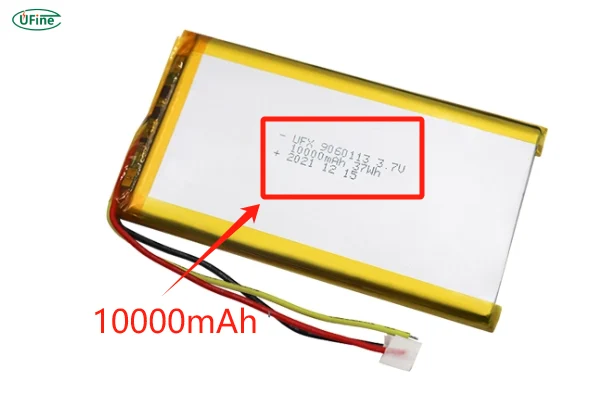
A 10000mAh battery, in theory, can deliver 10,000 milliamps for one hour, 1,000 milliamps for 10 hours, or 100 milliamps for 100 hours. It all depends on the device it’s powering. But remember, real-world usage involves power losses, so actual performance may vary.
Part 2.10000mAh lithium battery types comparison
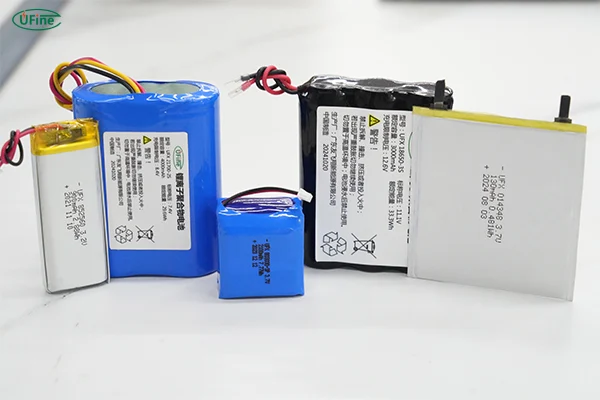
A 10000mAh capacity can be achieved using different lithium battery technologies. The best choice depends on the product requirements.
| Battery type | Main advantages | Common applications |
|---|---|---|
| Lithium-ion (Li-ion) | High energy density, mature technology, cost-effective | Power banks, portable electronics |
| Lithium polymer (LiPo) | Thin, lightweight, flexible shapes | Wearables, smart devices, consumer electronics |
| LiFePO4 | Long cycle life, excellent safety performance | Energy storage, industrial equipment |
| NMC lithium battery | High energy density and strong performance | Advanced portable devices |
A 10000 mah lithium ion battery is often selected for applications where compact size and high capacity are important.
For products requiring customized shapes, ultra-thin designs, or specific size limitations, lithium polymer batteries are often a better solution because pouch cells can be manufactured in various shapes and thicknesses.
And if you’re looking for tailored solutions, Ufine Battery offers both Li-ion and LiPo options in various sizes, voltages, and configurations. As a trusted Chinese lithium battery manufacturer, Ufine provides custom battery packs for consumer electronics, industrial tools, and more.
Part 3. What about voltage?
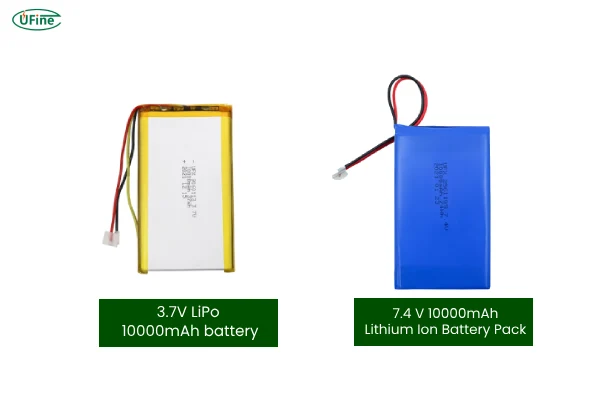
Now that we’ve tackled capacity, let’s talk voltage. Most 10000mAh batteries operate at 3.7V, which is the standard for a single Li-ion cell. However, some packs may be configured in series to output 7.4V, 11.1V, or more.
The voltage directly impacts how much power (in watt-hours) the battery can deliver. Here’s a simple formula:
Watt-hours (Wh) = Voltage (V) × Capacity (Ah)
So, a 10000mAh (which is 10Ah) 3.7V battery equals:
3.7V x 10Ah = 37Wh
This is crucial if you need to calculate energy use for more demanding applications.
Part 4. How long can a 10000mAh battery run? How to calculate it?
This is what everyone wants to know. The answer depends on the device you’re powering and how much current it draws.
Use this formula:
Run Time (hours) = Battery Capacity (mAh) / Device Load (mA)
Example: If your device uses 500mA, a 10000mAh battery will run it for:
10000 / 500 = 20 hours
However, that’s a best-case scenario. Heat, power conversion losses, and battery aging can shorten that.
Still, it’s a solid estimate to help you understand what kind of power you’re getting.
Part 5. 3.7V 18650 10000mAh battery vs. 10000mAh LiPo: which one?
A 10000mAh 18650 battery pack is usually made up of multiple 18650 cells in parallel. These are great if you want a rigid, durable battery.
On the other hand, a 10000mAh LiPo battery is flat, lightweight, and customizable in shape. These are often used in drones, tablets, and compact electronics.
Choose 18650 if:
- You need high energy output and long cycle life
- The shape and weight are not critical
Choose LiPo if:
- Space-saving is essential
- Your device is sensitive to weight or size
Still unsure which to pick? Ufine Battery can help you choose and customize the right format for your product. With expertise in 18650 packs, LiPo cells, and advanced lithium battery technology, they deliver quality you can count on.
Part 6. How long does a 10000mAh power bank last?
When people ask “how long does 10000mah power bank last,” they usually want to know either:
- How long the power bank itself can provide power.
- How many times it can charge another device.
A 10000mAh power bank is commonly used for smartphones because it offers a good balance between portability and capacity.
However, the actual charging capacity is affected by energy conversion efficiency.
For example:
A 10000mAh lithium battery:
- Nominal voltage: 3.7V
- Energy: about 37Wh
Assuming an efficiency rate of 85%:
37Wh × 85% = about 31.5Wh usable energy
For a smartphone with a 3500mAh battery:
- Smartphone battery energy: around 13Wh
Theoretically:
31.5Wh ÷ 13Wh ≈ 2.4 charges
In practice, most 10000mAh power banks provide around:
- 1.5–2 full charges for larger smartphones
- Around 2–2.5 charges for smaller phones
Factors such as fast charging, cable quality, phone temperature, and charging habits can affect the final result.
Part 7. Why does a 10000mAh battery deliver less than rated capacity?
Many users are surprised when a 10000mAh battery or power bank does not provide the full 10,000mAh capacity they expected. This does not mean the battery is defective. The difference comes from the fact that the rated capacity is measured under specific laboratory conditions, while real-world usage involves energy losses.
Several factors affect the usable capacity of a 10000 mah lithium battery.
Voltage conversion losses
Most lithium batteries operate at around 3.7V, while many electronic devices require different voltages.
For example, a power bank needs to convert:
3.7V battery output → 5V USB output
This voltage conversion requires a boost circuit, which consumes some energy. Even high-quality conversion systems usually have efficiency losses.
Battery management system (BMS) protection
Lithium batteries include protection circuits to improve safety and battery life.
A BMS helps prevent:
- Overcharging
- Over-discharging
- Excessive current
- Overheating
- Short circuits
Because the battery cannot safely use every last bit of stored energy, some capacity remains reserved for protection.
Temperature effects
Battery performance changes with temperature.
Extreme conditions can reduce the available capacity of a 10000mAh lithium ion battery.
- Low temperatures slow down chemical reactions and reduce output capability.
- High temperatures accelerate battery aging and may reduce long-term performance.
For products designed for outdoor, medical, or industrial applications, temperature requirements should be considered during battery selection.
Battery aging and cycle life
A new 10000mAh battery will not have the same capacity after hundreds of charging cycles.
Over time, lithium batteries naturally experience:
- Reduced active material performance
- Increased internal resistance
- Lower available capacity
A high-quality lithium battery design can help maintain performance over a longer service life.
Part 8. How long does it take to charge a 10000mAh battery?
Another common question is: How long does a 10000mAh battery take to charge?
The charging time depends on:
- Battery capacity
- Charger output current
- Charging efficiency
- Charging protocol
- Battery temperature
A basic calculation is:
Charging time = Battery capacity ÷ Charging current
For example:
A 10000mAh battery equals 10Ah.
With a 2A charger:
10Ah ÷ 2A = approximately 5 hours
However, lithium batteries use a special charging process called CC/CV (constant current/constant voltage) charging. During the final charging stage, the current gradually decreases to protect the battery, so the actual charging time is usually longer.
Typical charging times:
| Charger output | Estimated charging time for 10000mAh battery |
|---|---|
| 1A charger | Around 10–12 hours |
| 2A charger | Around 5–7 hours |
| Fast charging system | Around 2–4 hours depending on design |
For commercial products, engineers also need to consider charger compatibility, charging temperature, battery protection design, and certification requirements.
Part 9. Is a bigger battery always better?
We’ve all been tempted by big numbers. More mAh must be better, right? Not always.
A bigger battery means more weight, longer charging time, and higher cost. If your device only needs 3000mAh, then a 10000mAh battery is overkill. It might even damage your device if the voltage or size doesn’t match.
Instead, choose the battery that fits your real needs. Think about runtime, usage habits, and portability. That’s the smart way.
Part 10. What’s the price?
Prices vary based on chemistry, brand, and build quality. Here’s a rough guide:
- Basic 10000mAh Li-ion cell: $8 to $15
- Branded power banks: $15 to $40
- Custom industrial packs: $30 to $80 or more
Beware of deals that look too good. Quality matters. Cheap batteries can fail early or even pose safety risks. Always buy from trusted suppliers.
If you need high-quality custom packs, Ufine Battery offers affordable, certified lithium battery solutions for various applications. They’re known for working closely with clients to meet performance, safety, and size needs.
Part 11. Final thoughts: Is the 10000mAh battery worth it?
In many cases, yes—a 10000mAh battery gives you excellent runtime without being too bulky. It’s a favorite for power users, travelers, and anyone who hates being tethered to a wall socket.
A 10000mAh li-ion battery provides long-lasting power with a reliable performance profile. Whether you’re using it in a power bank, custom gadget, or backup system, it’s a smart investment for most people.
Just make sure to choose the right format and voltage. And don’t forget—safety and quality always come first.
If you’re looking for a trusted battery supplier, Ufine Battery is here to help. As a leading Chinese custom lithium battery manufacturer, they offer a wide range of LiPo batteries, LiFePO4 cells, cylindrical batteries, ultra-thin formats, high-rate models, and even high-temperature options.
Need a custom lithium battery solution? Contact Ufine Battery today and get expert support tailored to your needs.
Your devices deserve power you can count on. Now you know exactly what to look for.
Part 12. FAQs
How many times can it charge a phone?
If your phone has a 3000mAh battery, a 10000mAh power bank can charge it about 2.5 to 3 times, considering some energy loss.
Is it safe to fly with a 10000mAh battery?
Yes. Most airlines allow batteries under 100Wh. A 10000mAh 3.7V battery is 37Wh, which is within limits.
How long does it take to recharge?
With a standard 2A charger, it may take 5-6 hours. Faster charging depends on your battery’s input rating.
How long will the battery last before it degrades?
Most Li-ion batteries last 300-500 full charge cycles. After that, you’ll see reduced capacity.
Can I replace my original battery with a 10000mAh one?
Only if the voltage and dimensions match. Otherwise, it could damage your device.
Related Tags:

More Articles
LiFePO4 Voltage Chart Guide: Everything You Need to Know
Check the LiFePO4 voltage chart for 3.2V, 12V, 24V and 51.2V batteries. Compare SOC, charging voltage, cutoff limits and internal resistance.
Lithium Ion Cell Sizes: A Comprehensive Guide
Compare lithium ion cell sizes with a chart of dimensions, capacity ranges, cell types, applications, and key factors for selecting the right battery.
6 Volt Tractor Battery vs 12 Volt: Which One Fits Your Farm Equipment Best?
Compare 6V and 12V tractor batteries. Learn which voltage fits vintage or modern tractors, which specifications matter, and how to convert safely.
The Ultimate Guide to a Molten Salt Battery
Learn how a molten salt battery works, its main types, advantages, disadvantages, operating temperature, safety, and grid energy storage uses.
2000mAh Battery Runtime: How Long Will It Last in Real Devices?
Learn how to calculate 2000mAh battery runtime and backup time. See real device examples, power-loss factors, and battery replacement checks.