- Key Takeaways
- Part 1. What is inside a battery? (Core components explained)
- Part 2. What elements are used in different batteries?
- Part 3. Battery components vs battery elements (Quick comparison)
- Part 4. How to choose the right battery chemistry
- Part 5. Conclusion
- Part 6. FAQs about elements of a battery
Batteries power everything from phones to EVs. But what elements are used in batteries, and what is a battery made of in real engineering terms?
This guide explains battery components, key chemical elements, and material choices across common battery types. It is written for engineers, buyers, and technical decision-makers.
Key Takeaways
- A battery is made of four core components: anode, cathode, electrolyte, and separator.
- The most common battery elements include lithium, nickel, lead, zinc, manganese, and cobalt.
- Lithium-ion batteries dominate due to high energy density and long cycle life.
- Different chemistries are optimized for cost, safety, lifespan, or power output.
- Material selection directly affects performance, safety, and application suitability.
Part 1. What is inside a battery? (Core components explained)
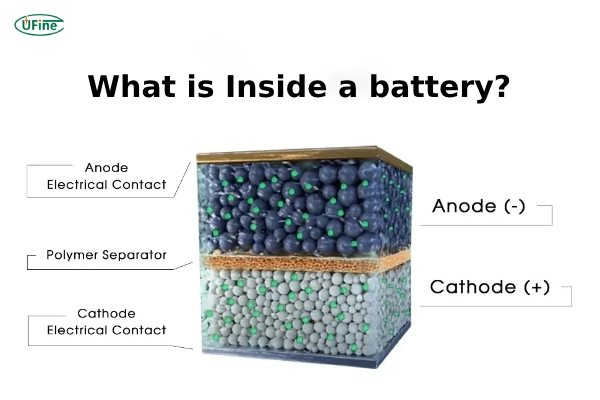
To understand what’s inside a battery, you need to look at its four essential parts:
1. Anode (Negative Electrode)
- Stores and releases electrons during discharge
- Common materials:
- Graphite (carbon-based) – stable, low cost
- Silicon-based – very high capacity (emerging)
- Lithium metal – ultra-high energy (next-gen)
- Lithium titanate (LTO) – fast charging, long life
👉 Learn more about advanced materials in our guide: high-performance battery materials and design
2. Cathode (Positive Electrode)
The cathode largely determines battery capacity, voltage, and cost.
Common cathode materials include:
- Lithium cobalt oxide (LCO) – high energy, used in electronics
- Lithium iron phosphate (LFP) – safer, long cycle life
- Lithium manganese oxide (LMO) – low cost, moderate performance
- NMC / NCA (nickel-based) – high energy density for EVs
These materials combine elements like:
- Lithium (Li)
- Nickel (Ni)
- Cobalt (Co)
- Manganese (Mn)
- Iron (Fe)
3. Electrolyte (Ion Transport Medium)
- Enables ion movement between electrodes
- Typically made of:
- Lithium salts (e.g., LiPF₆)
- Organic solvents
Without the electrolyte, no current flows internally.
For safety standards, refer to: NFPA energy storage safety guidelines
4. Separator
- A thin membrane (usually PP or PE)
- Prevents short circuits while allowing ion flow
- Critical for battery safety and thermal stability
Part 2. What elements are used in different batteries?
Different battery chemistries use different elements and materials, depending on application needs.
1 Lithium-Ion Batteries
Key elements used in batteries:
- Lithium (Li)
- Nickel (Ni)
- Cobalt (Co)
- Manganese (Mn)
- Carbon (C)
How it works: Lithium ions move between anode and cathode during charge/discharge.
Applications:
- Smartphones
- Laptops
- Electric vehicles
- Energy storage systems
👉 Related: 18650 battery pack design and structure
2 Nickel-Cadmium (NiCd) Batteries
Elements:
- Nickel (Ni)
- Cadmium (Cd)
Characteristics:
- Very durable
- Works in extreme conditions
- Memory effect issue
Applications:
- Industrial tools
- Aviation systems
3 Lead-Acid Batteries
Elements:
- Lead (Pb)
- Lead dioxide (PbO₂)
- Sulfuric acid (H₂SO₄)
Advantages:
- Low cost
- High reliability
Applications:
- Automotive batteries
- UPS backup systems
4 Zinc-Carbon Batteries
Elements:
- Zinc (Zn)
- Manganese dioxide (MnO₂)
Applications:
- Flashlights
- Remote controls
5 Nickel-Metal Hydride (NiMH)
Elements:
- Nickel (Ni)
- Hydrogen-absorbing alloys
Applications:
- Hybrid vehicles
- Consumer electronics
6 Alkaline Batteries
Elements:
- Zinc (Zn)
- Manganese dioxide (MnO₂)
- Potassium hydroxide (KOH)
Applications:
- Everyday household devices
Part 3. Battery components vs battery elements (Quick comparison)
| Category | Description | Examples |
|---|---|---|
| Components | Structural parts of a battery | Anode, cathode, electrolyte, separator |
| Elements | Chemical elements used in materials | Lithium, nickel, lead, zinc |
👉 In short: Components = structure | Elements = chemistry
Part 4. How to choose the right battery chemistry
When selecting a battery, focus on these engineering factors:
- Energy Density
- Lithium-ion (NMC, NCA) → high
- Lead-acid → low
- Safety
- LFP → very safe
- Lithium metal → higher risk
- Cycle Life
- LFP / LTO → long life
- LCO → shorter life
- Cost
- Lead-acid / zinc → low
- Nickel / cobalt systems → higher
Part 5. Conclusion
So, what element is used in batteries? There is no single answer.
Most batteries rely on a combination of elements such as:
- Lithium
- Nickel
- Lead
- Zinc
- Manganese
Each element plays a specific role in energy storage, conductivity, and stability. The final battery performance depends on how these materials are combined and engineered.
Part 6. FAQs about elements of a battery
What element is most commonly used in batteries?
Lithium is the most widely used element today, especially in rechargeable batteries, due to its high energy density and low weight.
What are the main components of a battery?
A battery consists of four main components: anode, cathode, electrolyte, and separator.
What is inside a battery?
Inside a battery are chemical materials (like lithium or lead compounds) and structural components that allow controlled electrochemical reactions.
Are all batteries made of lithium?
No. Many batteries use other elements such as lead, nickel, zinc, or manganese, depending on cost and application.
Why are different elements used in batteries?
Different elements offer different advantages in energy density, cost, safety, and lifespan, which determines their best use cases.
Related Tags:

More Articles

Can Battery Degradation Be Reversed on LFP Batteries?
Can battery degradation be reversed? Learn what causes LFP battery degradation, how degradation curves change, and how to slow LFP battery aging.
What’s the Difference Between Volts and Amps? A Beginner’s Guide
Learn the difference between volts and amps, how voltage and amperage work together, and how to calculate watts and current with simple examples.
Double A vs Triple A Battery: Understanding Size, Capacity, and Compatibility
Compare AA vs AAA batteries by size, voltage, capacity, runtime, chemistry, and compatibility. Learn which battery fits your device and lasts longer.
The Ultimate Guide to Battery Terminal Adapters
Compare battery terminal adapters for top post, side post, stud, marine, and U1 batteries. Learn how to choose, install, and maintain them safely.
What Can a 12V 50Ah Lithium Battery Power? Real-World Applications Explained
Learn what a 12V 50Ah lithium battery can power, realistic runtimes, inverter limits, charging methods, and uses for RVs, camping, solar, and backup.